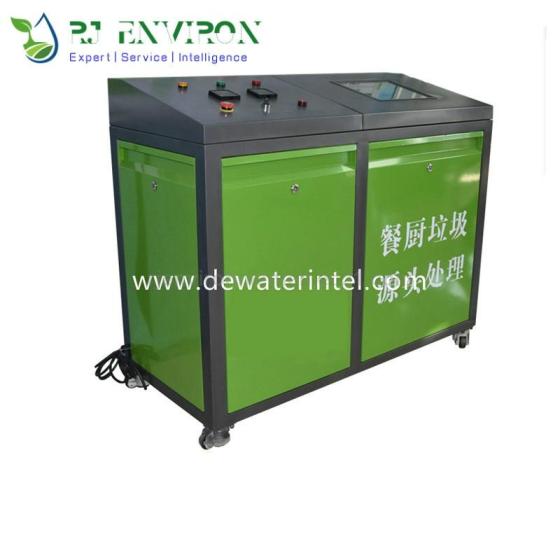
1. IntroductionThe kitchen waste solid liquid separator uses kitchen/fruit and vegetable organic waste as raw materials, through the dual shaftRoller shredding, squeezing dehydration, oil-water separation and other comprehensive treatment technologies for rapid decomposition. After setting the parametersIt can run automatically without manual operation. It can achieve rapid waste reduction, and the sewage can be discharged after subsequent treatmentIt is used as raw material for biomass fuel after recycling.
2. Working principle2.1. After the kitchen waste enters the equipment, it is firstly evenly crushed by a two-axis roller shredder, and the particle size after shredding at 10-20mm, the teeth of the shredder are made of high-strength alloy, and the size of the shredded kitchen waste is uniform and small tableware, bones and other hard objects that are not fully quantified are broken at the same time to avoid malfunctions during the operation of the equipment.
2.2The follow-up dehydration of slag with small particle size is more complete, the amount of reduction is more, the oil extraction rate is high, and the overall operation efficiency of the equipment is high.
3. After being shredded, the slag automatically enters the screw press dehydrator. The dehydration process of the screw press dehydrator is divided into two stages. In the first stage, the spiral auger is used for dehydration. The spiral auger is divided into three sections: transmission section, compression section and discharge section.The transmission section ensures that the material enters the equipment smoothly, and the spiral blade pitch of the dehydration section gradually decreases, so that the transmission space is stepwise. It becomes smaller, forming a gradually increasing pressure on the material, forcing the volume of the material to shrink and squeezing out water; the second stage is used the material blocking device is dehydrated. When the material enters the spiral auger discharge section, the spiral auger will exert an axial thrust on the material to pushing out, the material blocking device at the discharge port will exert a reverse force on the material to be pushed out, thus forming a squeezing force the material undergoes two-stage dehydration.
3. The extruded liquid of the squeeze dehydrator is transferred to the oil-water separator through the diaphragm pump, using the kinetic energy of the water flow to connect continued collision, the grease from small to large, thereby accelerating the movement, so that the oil and water of different proportions can be shunted and layered, which helps after the oil and water are separated by the density difference, it enters the next stage. The waste water makes turbulent movement under the siphon effect along the spoiler.After flowing from the overflow weir into the collection tank and discharged through the drainage port, the oil beads in the water gather and flow upward, floating in the oil-water separator The upper water surface, and then use the oil removal device to discharge it collectively, when the ambient temperature is low, the grease condenses, it can be heated byThe device heats the grease to facilitate the discharge of grease.3. Features3.1. National standard industrial grade 304 stainless steel, beautiful appearance, strong anti-corrosion ability and long service life;3.2. Touch screen intelligent control system, simple operation, comprehensive and safe design and low failure rate;3.3. The integrated structure integrates the three major functions of crushing, dehydration and oil extraction, with a small footprint and easy installation;3.4. High oil extraction rate and high purity of oil consumption, effectively removing 90% of floating oil and 15 emulsified oil in oil products.Water oil content ≤30mg/L;3.5. The processing speed is fast, the processing volume is large, and the reduction rate can reach about 50-70%;3.6. The machine adopts six major energy-saving and consumption-reducing designs: optimized design of electricity consumption, linear control, comprehensive insulation and heating efficiencyHigh, heat recovery, unique energy-saving system, reduce operating costs.3.7. The whole machine is composed of standard parts, modular components and equipment units. It is scientific and reasonable.Easy to install, easy to disassemble, easy to use, easy to maintain";3.8. The moisture content of the slag is low, and the moisture content of the waste residue after crushing and dehydration is in the range of 60%-70%, which is suitable for aerobic composting. Fermentation produces organic fertilizer.4. Technical parametersRated voltage220V 50HZMaterial304 stainless steel monitor rate 4kwheating power 1.1kwDiaphragm pump power0.5kwRotating speed 50r/minProcessing capacity200KG/HWeight260KGDimensions 1250*1000*1250mm shredding size10mmSpiral diameter110mmRunning noise≤65DB5. Application Mainly used in the local treatment of kitchen waste in residential areas, hotels, canteens, food streets and other dining places and kitchensCentralized treatment of waste treatment plants.
6. Design specifications and standards1. "Technical Specifications for Domestic Waste Composting" (CJJ/T52-1993);2. "Technical Specifications for Food Waste Treatment" (CJJ184-2012);3. "Design Hygienic Standards for Industrial Enterprises" (TJ 36-79);4. "Emission Standard of Odor Pollutants" (GB 14554-93);5. "Ambient Air Quality Standard" (GB 3095-1996);6. "Code for Construction Quality Acceptance of Ventilation and Air Conditioning Engineering" (GB50243-2002)7. "Code for design of heating, ventilation and air conditioning" (GB50243-2002);8. "Code for Construction and Acceptance of Water Supply and Drainage Pipeline Engineering" (GB50268-97).
For more information, visit www.dewaterintel.com.







Clients Reviews