Industry Insights
IronAxis Technical Team
12 Jan 2026
views (
)
Shikang has unveiled its latest high-performance, cost-effective area-array SPAD-SoC—SA100
Shikang remains committed to the broad adoption of 3D sensing technology to empower an intelligent future.
Ultra-Flexible 2D Binning
The SA100 features a resolution of 480 (H) × 384 (V) and supports multiple binning modes—including 1×1, 2×2, 4×4, and 2×8—with customizable horizontal and vertical partitioning. It also enables both 1D and 2D scanning, with typical partitions of 12 (H) × 1 (V) and 24 (H) × 8 (V) respectively, making it compatible with various LiDAR architectures such as solid-state and rotating-mirror systems.
dToF LiDAR + Single-Photon Camera
In 1×1 binning mode, the SA100 outputs a grayscale image at full 480 (H) × 384 (V) resolution, functioning as a high-dynamic-range single-photon camera ideal for low-light imaging. Critically, its 2D and 3D data are inherently aligned with zero error, enabling seamless fusion of dToF point clouds and grayscale images.
A Milestone in Integrated, Single-Chip Design
Built on Shikang’s fully chip-integrated technology, the SA100 integrates key components onto a single die: a high-performance backside-illuminated (BSI) SPAD array, a precision time-to-digital converter (TDC) matrix, a single-photon ranging engine (TCSPC), a high-throughput dToF perception algorithm accelerator (DSP), a LiDAR control center (Lidar Controlling Master), and high-speed data interfaces. Notably, it features two dedicated processing units: the Intelligent Ranging Engine (IRE) and the Lidar Controlling Master (LCM).
Higher Precision and Accuracy
Leveraging the IRE, the SA100 can simultaneously acquire and process data from thousands of pixels, effectively addressing challenges in synchronization, filtering, peak detection, noise reduction, and compensation during ranging. This significantly enhances signal-to-noise ratio and delivers high accuracy while resisting interference from multiple LiDARs and ambient light.
Satellite Architecture for Lower Cost
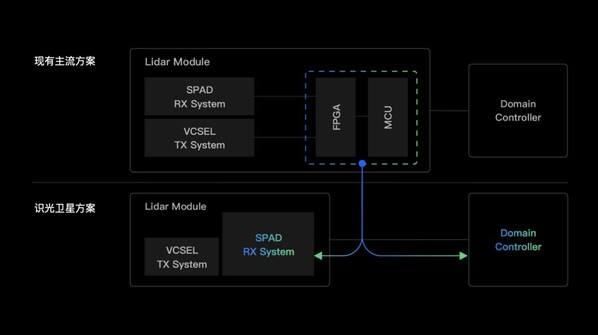
Thanks to its high level of integration, the SA100 enables Shikang’s innovative “Satellite Architecture” for LiDAR and autonomous driving solutions. Eliminating the need for external FPGA or MCU, the SA100 performs on-chip LiDAR data processing and transmits results directly to the domain controller. This shifts computational load upward, allowing centralized multi-sensor fusion at the domain level—dramatically reducing both cost and physical footprint of LiDAR systems.
Shikang at CES 2026
Shikang made its debut at CES 2026, showcasing its SPAD-SoC product family—including the newly launched single-pixel SK103/SK104 chips and a 2D solid-state LiDAR prototype based on the area-array SPAD-SoC. Shikang remains steadfast in its mission to drive widespread adoption of 3D sensing technology, ensuring advanced capabilities serve everyone.
Source: Suzhou Shikang Technology Co., Ltd.


